



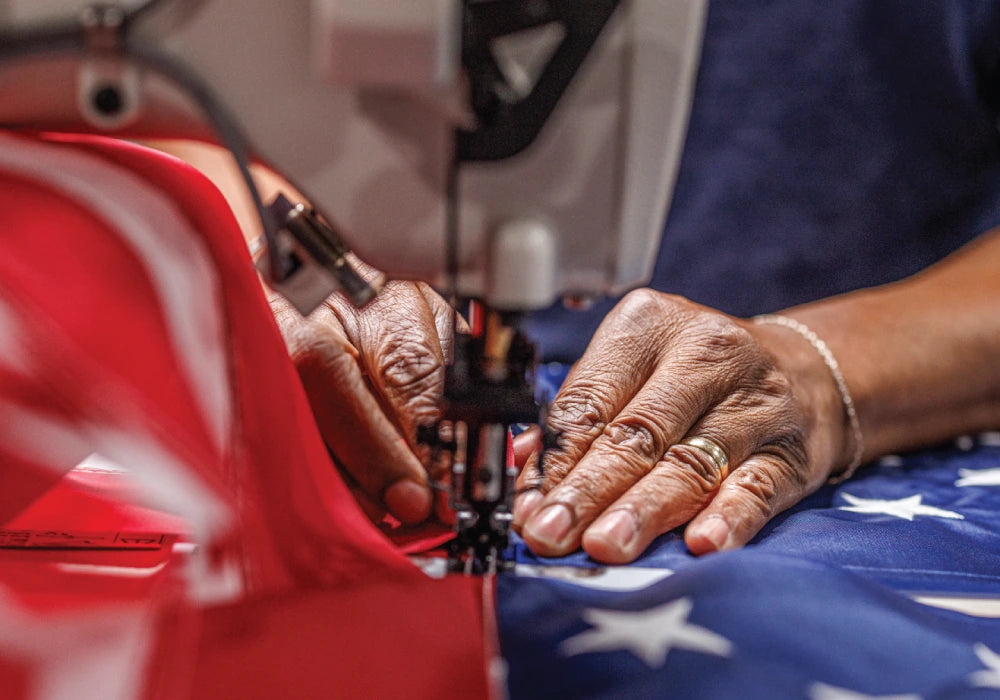

The American flag has a rich history dating back to the 1700s, when the American Revolution and the colonies of the United States fought for independence from Britain. Before the flag we know came into existence, there was another 13-colonies flag known as The Grand Union, which had 13 stripes representing the 13 colonies of the United States, but also included the Union Jack, which signified that the troops were fighting under British rule. In June of 1777, the modern USA flag began when the nation declared its independence, and it was suggested that a national flag be designed.
Historical Evolution of the Flag
The chronological changes and key milestones in the design and adoption of the American flag highlight significant events and periods that influenced its development.
Betsy Ross
There is much controversy over whether or not Betsy Ross designed the first flag. It was believed that she did because there were only a few places you could go to get a flag made, and one was an upholsterer. Betsy Ross was an upholsterer who designed flags for the Navy in Pennsylvania. Another clue as to whether she designed the flag was when her grandson spoke at the Historic Society of Philadelphia and told the audience that his grandmother told him she was at the meeting with George Washington when the flag was discussed.
When independence was declared in 1776, a new flag had not yet been designed. Some suggest that seamstress Betsy Ross designed the first flag with 13 red and white stripes and a blue field in the corner. The original Betsy Ross flag featured 13 stars in a circle on a blue field to represent the 13 colonies that made up the independent United States. This was the first iteration of the American flag we now know. There is another belief that the designer of the Declaration of Independence also designed the American flag, but the legend of Betsy Ross is still strong, and the American flags that hold her original design are also named after her.
American Flag Timeline
Starting in May of 1776 with what is commonly known as the Betsy Ross flag, the American flag has gone through close to 42 designs, from the original 13 colonies to the addition of Hawaii as the 50th state in 1960. The flag always remained true to the colors chosen for this symbol of independence, but because there was never any clear direction on which way the stars and stripes should be displayed, many flag makers chose their own designs. In 1912, President Taft finally solidified the design, including the 13 stripes and 50 stars we see today. Other than the addition of the 48th, 49th, and 50th states, this design has not changed. In 1949, President Truman called for an official holiday called Flag Day to honor this nation's beacon of independence and sacrifice. This day is significant in American flag history, and there are many celebrations across the country to mark this momentous occasion.
The Colors Red, White, and Blue
The red and white in the USA flag have very specific meanings, as does the blue field that holds the stars. The patriotic flag we know today still bears those colors and holds the modern design that has been the standard for the last fifty years. The red in the flag symbolizes courage and readiness to sacrifice, qualities that were significant in the fight for independence that inspired the flag. White is for pure intentions and high ideals, traits that Americans hold dear to their hearts. Blue is for vigilance and justic,e which are cornerstones of American ideals and values.
The New Constellation
The 13 stars that graced the flag over 200 years ago were coined "a new constellation" by Congress and were said to embody a light for mankind and bright new hope. The flag continues to inspire and bring hope to many since it was first made and can be seen all over communities in the United States.
Notable Historical Flags
A deeper exploration of notable historical versions of the American flag reveals a tapestry of banners that have not only marked pivotal moments in U.S. history but have also survived as invaluable artifacts, connecting present generations to the nation's formative struggles and triumphs. Among the most significant surviving flags is the Forster Flag, which historians believe was carried by the Manchester Company during the battles of Lexington and Concord in 1775. This flag is widely regarded as the oldest extant flag associated with the original thirteen colonies, and its preservation offers a rare, tangible link to the earliest days of the American Revolution. Another enduring symbol is the Brandywine Flag, attributed to the Chester County Militia and used during the 1777 Battle of Brandywine. Now housed at Independence National Historical Park, the Brandywine Flag exemplifies how local regiments crafted unique banners that reflected both their identity and the broader cause of independence.
Perhaps the most famous surviving American flag is the Star-Spangled Banner, which flew over Fort McHenry during the War of 1812 and inspired Francis Scott Key to pen the lyrics of what would become the national anthem. This massive flag, originally measuring 30 by 42 feet, has been meticulously conserved by the Smithsonian National Museum of American History. Preservation efforts have included carefully stabilizing its fabric, controlling light exposure, and providing a climate-controlled display to prevent further deterioration. The Star-Spangled Banner’s ongoing conservation is a testament to the nation’s commitment to safeguarding its historical treasures for future generations.
Another iconic flag is "Old Glory," the name given by sea captain William Driver to his cherished flag in the early 19th century. Driver’s "Old Glory" accompanied him on numerous voyages and later survived the tumult of the Civil War, during which it was hidden from Confederate forces and ultimately displayed above the Tennessee State Capitol when Union troops reclaimed Nashville. Today, "Old Glory" is preserved at the Smithsonian, where it continues to inspire visitors with its story of resilience and patriotism.
Preserving these historic flags is a complex, ongoing process that often involves textile conservators, historians, and museum professionals. Techniques such as mounting on supportive fabrics, regulating humidity and temperature, and limiting handling are essential to prevent further wear. Many of these banners are now showcased in museums across the United States, including the Smithsonian, Independence National Historical Park, and the Bennington Museum, where the Bennington Flag is displayed. These institutions not only protect the physical flags but also interpret their stories for the public, ensuring that the legacy of the American flag is not only remembered but experienced firsthand. Through these surviving flags and the dedicated efforts to preserve them, Americans can connect with the nation’s past in a direct and meaningful way, appreciating both the artistry and the enduring symbolism of the Stars and Stripes.
The Enduring Symbolism and Meaning of the American Flag’s Elements
Since its inception, the American flag has served as a vivid tapestry of national ideals, with every element, its colors, stars, and stripes, imbued with layered meanings that have evolved alongside the nation itself. The flag’s red, white, and blue palette, while originally chosen without an official explanation, came to be deeply associated with the character and aspirations of the United States. In 1782, Charles Thomson, Secretary of the Continental Congress, articulated the symbolism behind these hues: red stands for hardiness and valor, white for purity and innocence, and blue for vigilance, perseverance, and justice. These interpretations have become widely accepted and are echoed in the way Americans understand their history and values, with red recalling the courage and sacrifices made in pursuit of independence, white representing the nation’s founding ideals and high moral purpose, and blue embodying the steadfast resolve to uphold justice and unity. Over time, presidents and public figures have offered their own reflections, further enriching the flag’s meaning and ensuring its relevance to each generation.
The thirteen stripes of the flag, alternating red and white, serve as a direct tribute to the original thirteen colonies that declared independence from Great Britain. These stripes are more than mere historical markers; they are visual reminders of the unity and shared struggle that birthed the nation. The stripes’ enduring presence, even as the country expanded, reinforces the idea that the nation’s foundation remains rooted in collective effort and enduring principles. The decision to maintain thirteen stripes while adding stars for new states speaks to a balance between honoring the past and embracing growth, a theme that resonates in the American story.
Equally significant are the stars, whose number has grown from thirteen to fifty, each representing a state within the Union. The stars are arranged on a blue field, often referred to as the “union,” symbolizing the coming together of diverse states into a single nation. The original arrangement of the stars, sometimes in a circle, sometimes in rows, was left to the discretion of early flag makers, reflecting the young country’s spirit of experimentation and individuality. Congress described the stars as a “new constellation,” suggesting hope, guidance, and the emergence of a new nation destined to shine among the world’s powers. As new states joined the Union, the addition of stars became a celebratory act, marking the nation’s expansion and the ongoing fulfillment of its founding promise.
Throughout American history, the flag’s elements have inspired a sense of belonging, pride, and purpose. The flag has been carried into battle, raised in triumph, and draped in mourning, each time serving as a powerful symbol of the nation’s ideals and collective identity. Its elements have been invoked in speeches, art, and song, reinforcing their meanings and ensuring that the flag remains not just a piece of fabric, but a living symbol of unity, resilience, and hope for generations past, present, and future.
Cultural and International Impact
The American flag holds a unique place not only within the borders of the United States but also on the global stage, where it stands as a powerful emblem of the country’s ideals, influence, and presence. Internationally, the flag is often seen as a symbol of freedom, democracy, and opportunity, values closely associated with the American identity. Its image is frequently displayed at U.S. embassies, military bases, and diplomatic missions around the world, signaling both the presence and protection of American citizens and interests abroad. The flag’s appearance during international events, such as the Olympic Games or United Nations assemblies, serves as a visual representation of national pride and unity, fostering a sense of belonging among Americans overseas while also communicating the nation’s values to a global audience.
Beyond official government use, the American flag has permeated popular culture and commerce internationally. It is commonly featured in art, fashion, and media, where it can represent anything from admiration for American culture to a broader statement about freedom or rebellion. In some countries, the flag is adopted by protestors or activists who wish to invoke the ideals it represents, while in others, it may be used in demonstrations as a critique of U.S. policies, reflecting the complex and sometimes contradictory meanings attached to the symbol. The flag’s presence in humanitarian missions often underscores America’s role on the world stage as a provider of aid and support, further cementing its image as a beacon of hope and assistance. At the same time, the American flag can be a focal point for political or cultural tensions, serving as a rallying symbol for both allies and critics. Its display can evoke strong emotional responses, ranging from admiration and solidarity to protest and dissent, depending on the historical and cultural context. The American flag’s influence transcends its physical form, functioning as a dynamic cultural symbol that reflects both the aspirations and the controversies associated with the United States. Its enduring presence in international contexts highlights the flag’s power not only as a national emblem but also as a global icon with deep and varied significance.
Flag Etiquette and Usage
The American flag is a powerful symbol of national pride and unity, and showing proper respect for it is an important tradition in the United States. Flag etiquette is guided by the United States Flag Code and a set of customs developed over many years. Observing these guidelines ensures the flag is always displayed, handled, and maintained with the dignity it deserves, whether at home, in public, or during special events.
-
Displaying the Flag Outdoors: The American flag should be displayed from sunrise to sunset on buildings and flagpoles in the open. If you wish to display the flag at night, it must be properly illuminated. The flag should not be displayed during inclement weather unless it is made of all-weather material. On national holidays and special occasions, it is customary to fly the flag at full staff, unless otherwise directed.
-
Raising and Lowering the Flag: When raising the flag, it should be hoisted briskly and lowered ceremoniously. The flag should never touch the ground or any object beneath it while being raised or lowered. On Memorial Day, the flag is flown at half-staff until noon, then raised to full staff for the remainder of the day. Lowering the flag at sunset is a sign of respect, unless the flag is properly illuminated for nighttime display.
-
Displaying the Flag Indoors: When displayed indoors, the flag should be placed to the right of the speaker or staging area, or to the right of the audience if there is no speaker. If displayed flat against a wall or in a window, the union (blue field with stars) should always be at the top and to the observer’s left. The flag should never be used as drapery, covering, or decoration for a platform or podium.
-
Position of Honor Among Other Flags: When displayed with other flags, the American flag must always be placed in the position of highest honor. It should be at the center and highest point when grouped with other flags, or to its own right if displayed with state or local flags. No other flag should be placed above or to the right of the U.S. flag, and it should never be dipped to any person or thing. The flag should never touch the ground, floor, water, or anything beneath it. It should not be carried flat or horizontally, but always aloft and free. The flag should not be used as clothing, bedding, or drapery, nor should it be printed on disposable items. Any display or handling of the flag should reflect the respect and reverence due to this national symbol.
-
Displaying the Flag at Half-Staff: The flag is flown at half-staff as a sign of mourning or respect for designated occasions and individuals, such as on Memorial Day, following the death of certain government officials, or as directed by the President or state governors. To lower the flag to half-staff, it should first be raised briskly to the top of the staff, then slowly lowered to the halfway point. When retiring for the day, it should again be raised to the top before being fully lowered.
-
Retiring and Disposing of the Flag: When a flag becomes worn, faded, or tattered and is no longer fit for display, it should be retired in a dignified manner, preferably by burning in a respectful ceremony. Many veterans’ organizations and community groups offer flag retirement services. It is important to ensure that the flag is disposed of with the same honor and respect with which it was displayed.
By following these time-honored customs, individuals and organizations can demonstrate their respect for the American flag and the values it represents. Proper flag etiquette not only honors the symbol itself but also the nation and people it stands for, fostering a sense of unity and shared purpose across the United States.
Legislation and Official Acts Shaping the American Flag
There are various laws, resolutions, and acts passed by governmental bodies that have defined and regulated the flag's design, proportions, and use throughout history. The first significant law was the Flag Resolution of 1777, which established the original design of thirteen stripes and thirteen stars. Subsequent acts, such as the Flag Acts of 1794 and 1818, adjusted the number of stars and stripes to reflect the nation’s growth, ultimately standardizing thirteen stripes and adding a star for each new state. In 1912, President Taft issued an executive order specifying the flag’s proportions and star arrangement, while the Federal Flag Code of 1942 provided guidelines for its proper display and respect.
Design Specifications and Variations
Understanding these elements provides insight into how the flag’s appearance has been shaped by both tradition and regulation.
-
Official Dimensions and Proportions: The current American flag is defined by precise proportions: the flag’s width-to-height ratio is 1.9:1, as specified by Executive Order 10834. The canton (blue field) covers the top left corner, spanning seven stripes in height and two-fifths of the flag’s length. Each of the thirteen stripes is of equal width, and the stars are arranged in nine offset horizontal rows, ensuring a balanced and uniform appearance.
-
Color Standards and Specifications: The flag’s colors are standardized for official use, though not by law. Federal specifications refer to “Old Glory Red” (Pantone 193C), “White,” and “Old Glory Blue” (Pantone 281C), with exact shades provided for government-produced flags. While these standards help maintain consistency, commercial flags may use slightly different hues. The careful selection and regulation of these colors ensure that the flag’s visual impact remains strong and recognizable in all contexts.
-
Evolution of Patterns and Arrangements: Early American flags varied widely in star arrangements, with circles, rows, and other creative patterns. It wasn’t until 1912 that President Taft’s executive order standardized the arrangement, specifying the number of rows and the orientation of the stars. Each new state’s admission prompted the addition of a star, leading to the current 50-star pattern adopted in 1960. This evolution reflects both the growing nation and the desire for visual harmony in the flag’s design.
-
Variations in Flag Construction and Display: Beyond official specifications, the American flag has seen variations in materials, stitching, and decorative elements like gold fringe. Sizes can vary depending on use, but the proportions remain consistent for authenticity. While government flags strictly follow federal guidelines, privately made flags often prioritize durability or aesthetics, leading to minor deviations. These variations highlight the flag’s adaptability while preserving its core identity.
Through these technical design aspects, the American flag continues to serve as a visually powerful and unified emblem of the United States. Its design tells a story of precision, adaptation, and enduring national identity.
The American flag is now a common sight to see displayed from front lawns, porches, and windows. The US flag dimensions may vary from case to case, but the design remains the same and hasn't changed in the last 50 years. In the complex history of the American flag, there are still mysteries that abound about who designed the original. Regardless of what may be true, the national flag continues to be a source of pride and independence for the citizens of the United States. Celebrate the nation’s heritage with a beautifully crafted American flag by choosing one made with pride and precision from Allegiance.