



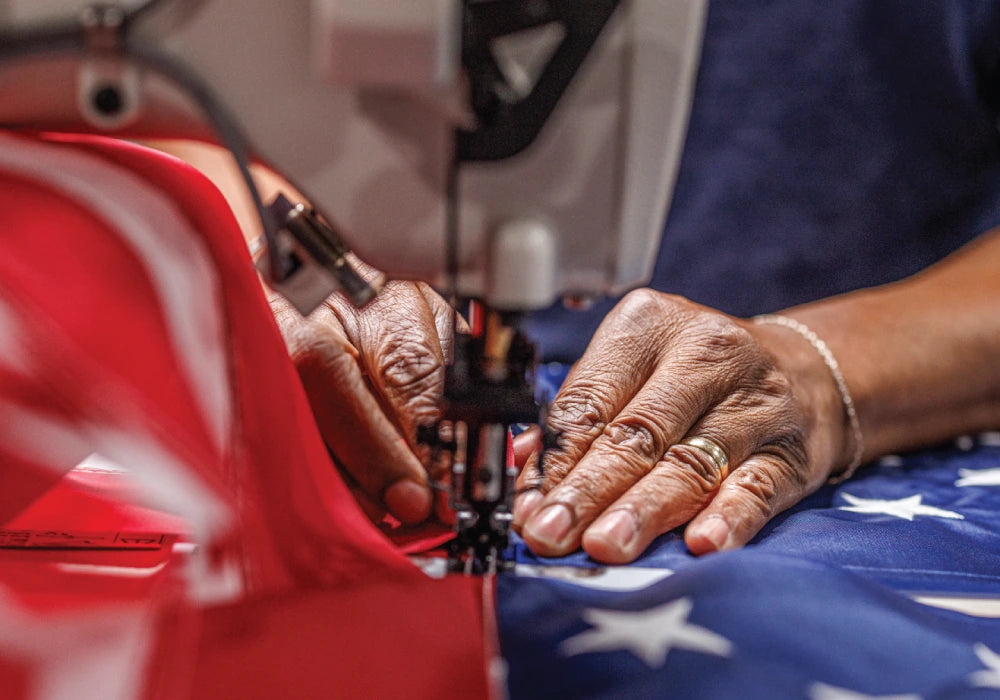

The story of the American flag is inseparable from the people and moments that shaped the nation’s earliest days, and few figures are as closely associated with that story as Betsy Ross. For generations, her name has been linked to the creation of the first American flag, a symbol that would come to represent independence, unity, and national identity. While some elements of her story blend documented history with long-standing tradition, Betsy Ross remains an enduring part of America’s founding narrative. Understanding who she was, how the iconic flag design emerged, and why it continues to resonate today offers valuable insight into the origins of one of the country’s most powerful symbols. This article explores Betsy Ross’s life, the design and meaning of the flag attributed to her, and the role the Betsy Ross flag continues to play in American culture and patriotic expression.
Betsy Ross’s Biography
One must learn the background information about Betsy Ross herself, her life, and her role in American history. Betsy Ross, born Elizabeth Griscom in 1752, grew up in a large Quaker family in colonial Philadelphia. From an early age, she was trained in sewing and upholstery, skills that would shape her future. After completing her education at a Quaker school, she apprenticed with an upholsterer, where she met John Ross, whom she married against her family’s wishes, resulting in her expulsion from the Quaker community. Despite this, Betsy persevered, and together with John, she opened their own upholstery shop. Widowed young when John died in a gunpowder explosion during the Revolutionary War, Betsy continued to run her business independently, a rare feat for a woman of her time. Throughout her life, she married twice more. Both husbands also died as a result of the war or its hardships. Betsy’s resilience in the face of personal loss and societal expectations highlights her determination and resourcefulness.
Ross’s expertise extended beyond household items. Colonial American upholsterers often produced flags, banners, and military accoutrements. Her business acumen and reputation for quality work brought her into contact with prominent Philadelphians, including George Washington, Robert Morris, and George Ross. Some accounts, notably from her descendants, suggest that her acquaintance with these influential figures led to her being asked to sew the first American flag. While the historical evidence for this encounter is debated, there is no doubt that Betsy contributed materially to the Revolutionary cause by producing uniforms, tents, and flags for the Continental Army.
Betsy Ross’s name became synonymous with the American flag largely due to the story popularized by her grandson, William Canby, in 1870, almost a century after the events. Modern historians note that while Betsy was one of several flag makers in Philadelphia, and her role as the sole creator of the first flag is unproven, her story endures as a symbol of women’s contributions to American history. Regardless of the legend’s accuracy, Betsy Ross’s life exemplifies the challenges and triumphs of women during the Revolutionary era, and her legacy continues to inspire discussions about patriotism, entrepreneurship, and the evolving narrative of America’s past.
The Betsy Ross American Flag
She is said to have been visited by a group of men from the Second Continental Congress, including George Washington, in May 1776. They asked her to sew a flag for the new nation. She is said to have created the first American flag with 13 stars and 13 stripes. She is also said to have used a new type of sewing technique to create the flag. In 1776, Betsy Ross was commissioned by the Second Continental Congress to sew the first American flag.
Betsy Ross Flag’s Design Elements and Symbolism
The Betsy Ross flag stands as one of the most distinctive and enduring symbols of America’s early identity, instantly recognizable by its harmonious arrangement of thirteen five-pointed stars in a circle on a blue canton and thirteen alternating red and white stripes. Each design element of this flag was carefully chosen as a visual embodiment of the values, aspirations, and unity of the fledgling United States. To fully appreciate the significance of the Betsy Ross flag, it is essential to examine not only its physical features but also the layers of meaning that have been attributed to them over time.
The most striking feature of the Betsy Ross flag is undoubtedly the circle of thirteen white stars set against a deep blue field in the upper left corner, known as the canton. Each star represents one of the original thirteen colonies that, in 1776, declared independence from Great Britain. The use of stars as symbols was not new, but their arrangement in a perfect circle was a powerful innovation. The circle configuration was not mandated by the Flag Act of 1777, which simply stated that the union should be “thirteen stars, white in a blue field, representing a new constellation,” but it soon became associated with the Betsy Ross flag through popular art and storytelling. The circle is widely interpreted as a symbol of equality and unity: by placing each colony equidistant from the center, the design visually asserts that no state is above another, and all are joined in a perpetual, unbreakable union. This symbolism was especially poignant during a time when the new nation was striving to forge a sense of collective identity among states with diverse interests and histories.
The choice of five-pointed stars, as opposed to six- or more-pointed alternatives, also carries significance. According to enduring tradition, Betsy Ross herself demonstrated to the flag’s commissioners how a five-pointed star could be cut with a single snip of the scissors, making it both practical for sewing and visually distinctive. While earlier proposals considered six-pointed stars—possibly influenced by heraldic designs or the Washington family coat of arms—the five-pointed star became a defining feature of the flag and, by extension, the nation. Over time, the star has come to symbolize the ideals of aspiration, guidance, and the pursuit of a higher purpose—qualities that the new republic sought to embody. The use of stars in a “new constellation” further reinforced the idea that the United States was a fresh presence on the world stage, charting its own course among the established nations.
Beneath the canton, the flag features thirteen alternating horizontal stripes running the full length of the flag. Like the stars, each stripe represents one of the original colonies, reinforcing the themes of unity and shared purpose. The use of stripes as a symbol of resistance and collective action predates the national flag; for example, the “Sons of Liberty” flag, a banner of protest against British rule, featured nine red and white stripes and became a rallying symbol during the pre-revolutionary period. By incorporating stripes into the national flag, the designers built upon an established visual language of rebellion, independence, and solidarity. The alternating pattern of red and white also creates a sense of rhythm and balance, visually echoing the ideals of equality and harmony among the states.
The colors of the Betsy Ross flag—red, white, and blue—are deeply evocative, though their meanings were not officially defined at the time the flag was adopted. The Flag Act of 1777 specified the colors but did not assign symbolism to them. However, in 1782, Charles Thomson, Secretary of the Continental Congress, articulated meanings for these colors when describing the Great Seal of the United States. According to Thomson, white stands for purity and innocence; red signifies hardiness and valor; and blue represents vigilance, perseverance, and justice. While these interpretations were initially intended for the Great Seal, they have since become closely associated with the flag itself, providing a moral and philosophical framework for understanding its design. The colors also served a practical purpose, as the dyes used, indigo for blue and cochineal for red, were among the most durable and vivid available at the time.
It is important to note that the specific arrangement of the stars and stripes was not universally standardized in the early years of the republic. The Flag Act left room for variation, and historical flags from the era display a range of star patterns, including rows, staggered lines, and other geometric shapes. The circular arrangement, however, gained prominence through its association with the Betsy Ross legend and through its frequent depiction in art, literature, and commemorative events. Over time, this version became the most iconic representation of the nation’s first flag, serving as a visual shorthand for the unity and egalitarian ideals of the American Revolution.
The symbolism embedded in the Betsy Ross flag extends beyond its immediate historical context. The circle of stars has been interpreted as representing the perpetual union of the states, with no beginning or end, a concept that resonated strongly during later periods of national crisis, such as the Civil War. The stripes, meanwhile, have come to symbolize not only the original colonies but also the broader themes of liberty, resistance, and the enduring struggle for justice. The flag’s colors, too, have taken on additional layers of meaning over time, becoming emblematic of the nation’s highest ideals and aspirations.
The Betsy Ross Flag Today
Today, this early version of the United States flag is frequently displayed at patriotic events, historical reenactments, and national holidays such as Independence Day and Flag Day. For many Americans, flying the Betsy Ross flag is a way to honor the spirit of the nation’s founding, evoking the ideals of unity, perseverance, and the collective struggle for independence represented by the original thirteen colonies. The flag’s iconic design has been embraced by a wide array of groups and individuals, from historical societies and museums to local communities and private citizens, who see in it a direct link to the nation’s formative years and the values enshrined in its creation.
In addition to traditional displays, the Betsy Ross flag has found its place in popular culture, appearing in films, literature, sports, and even fashion. Its distinctive circle of stars is featured on the seal of the U.S. Department of Veterans Affairs, symbolizing the enduring connection between past and present service members. The design also appears in state flags and logos, such as the Philadelphia 76ers basketball team, which incorporates the circle of stars as a nod to the city’s historical significance. During major national events, the Betsy Ross flag is often displayed alongside the current American flag, serving as a visual reminder of the country’s origins and the evolution of its national symbols.
However, the flag’s modern relevance is not without complexity. In recent years, the Betsy Ross flag has occasionally become a subject of public debate, as its imagery has been adopted by various groups with differing intentions. While for most people it remains a symbol of American heritage and unity, some instances have seen it used in contexts that sparked controversy and discussion about its meaning in contemporary society. This has prompted ongoing conversations about the flag’s place in American culture, the interpretation of historical symbols, and the importance of context when displaying national emblems.
Despite these debates, the Betsy Ross flag endures as a powerful emblem of the American narrative. Its continued use reflects a broader desire to connect with the nation’s founding stories and to celebrate the principles of liberty and equality that shaped the United States. For educators, historians, and patriots alike, the flag offers a tangible link to the Revolutionary era, inviting reflection on the country’s journey from its earliest days to the present. Whether flown from a porch, featured in a classroom, or carried in a parade, the Betsy Ross flag remains a living symbol. One that both honors the past and sparks dialogue about the values and challenges of American identity today.
Frequently Asked Questions
The American flag has a rich history and is the subject of many questions regarding its design, evolution, and official standards. Below, you’ll find answers to some of the most common questions about the flag’s origins, changes, and present-day form.
Who designed the first American flag?
The first official American flag’s designer is not definitively known, though Francis Hopkinson, a signer of the Declaration of Independence, is widely credited by historians.
How many stars and stripes does the current flag have?
The current flag features 50 stars representing the states and 13 stripes symbolizing the original colonies.
What do the colors of the American flag represent?
While not officially assigned meanings, red often stands for valor, white for purity, and blue for vigilance and justice.
How often has the American flag changed?
The flag has changed 27 times, usually when new states joined the Union, and stars were added.
When was the current 50-star flag adopted?
The 50-star flag was officially adopted on July 4, 1960, after Hawaii became the 50th state.
Are there official rules for displaying the flag?
Yes, the United States Flag Code provides detailed guidelines for displaying, handling, and caring for the flag.
Can the flag touch the ground?
According to the Flag Code, the flag should never touch the ground as a sign of respect.
Is it legal to burn the American flag?
The Supreme Court has ruled that flag burning is a form of protected free speech under the First Amendment.
What should be done with a worn or damaged flag?
A flag that is no longer fit for display should be retired in a dignified manner, preferably by burning.
Why are there thirteen stars arranged in a circle on the Betsy Ross flag?
The thirteen stars in a circle represent the original thirteen colonies, with the circle symbolizing equality and unity. No colony is above another, and all are joined in a perpetual union.
What is the significance of the five-pointed stars?
Five-pointed stars were chosen for their practicality and distinctiveness. Tradition holds that Betsy Ross demonstrated how to easily cut them, making them a defining element of the flag’s design.
What do the colors red, white, and blue represent on the Betsy Ross flag?
Although not originally assigned meanings, later interpretations state that red symbolizes valor and hardiness, white stands for purity and innocence, and blue represents vigilance, perseverance, and justice.
Was the circular arrangement of the stars mandated by law?
No, the original Flag Act did not specify the arrangement of the stars. The circle became iconic through popular art and storytelling, symbolizing the unity and equality of the states.
Betsy Ross and the flag associated with her name occupy a unique place in American history, blending documented fact with enduring tradition. While historians continue to debate the details surrounding the first American flag, the symbolism behind the Betsy Ross flag remains powerful. It represents a young nation defining itself through unity, craftsmanship, and shared ideals during a moment of extraordinary change. Whether viewed as a historical artifact or a living symbol of patriotism, the Betsy Ross flag encourages reflection on the nation’s origins and the individuals who helped shape its identity. Honor that legacy by flying a high-quality, American-made flag from Allegiance and proudly displaying your commitment to the values it represents.