



The American flag is a powerful symbol of the nation, but how American flags are made is a fascinating process that combines modern technology with traditional handcrafting. Americans purchase roughly 150 million U.S. flags each year, and about 94% of those are made domestically. From the enormous garrison flags of the 19th century to the common 3x5 American flag flown by households today, every U.S. flag shares a story of careful construction and patriotic pride. This article provides a general-audience, technical look at the craftsmanship behind American-made American flags, exploring the materials, techniques, and dedication involved. By understanding the flag’s journey from fabric to finish, we can better appreciate the quality and tradition sewn into every stitch.
From Hand-Stitched Beginnings to Industrial Sewing
The tradition of handcrafted American flags dates back to the nation’s founding. Early American flags in the late 18th century were entirely hand-sewn by individuals like Betsy Ross and other seamstresses and sailmakers working with available materials such as wool bunting, linen, and cotton. Each flag was unique, so makers applied their own craftsmanship and judgment. This personalized approach continued through the War of 1812, when demand for durable flags grew.

A famous example is the giant 15-star, 15-stripe flag that Mary Young Pickersgill hand-stitched for Fort McHenry in 1813. That massive flag measured 30 by 42 feet and required heavy wool bunting, linen thread, hand-cut cotton stars, and reinforced stitching strong enough to withstand cannon fire. It was crafted so well that it survived the British bombardment and inspired the poem that became the national anthem. Such stories show how necessity elevated flag-making into an art: early flags were not just symbols, but physical products of skill and care meant to endure harsh conditions.
Throughout the 19th century, flag production gradually industrialized, but the human touch remained crucial. The introduction of the sewing machine in the mid-1800s dramatically sped up output, allowing flag makers to produce more as the number of stars grew with each new state. By the late 1800s, factories could cut and sew flags more efficiently, yet many steps were still done by hand or required careful oversight. Stars were often appliquéd by hand, seams and edges were reinforced manually, and grommets were set one at a time.
Flagmaking became a specialized trade predominantly carried out by skilled women workers, and quality was a point of pride. This blend of handcrafting and machinery continued into the 20th century. Even as huge volumes of flags were needed during World Wars and beyond, experienced craftspeople ensured that each flag met high standards. Over time, the U.S. government introduced official guidelines for flag proportions and star arrangements, further standardizing the product.
Quality Materials and Official Specifications
Modern American flag manufacturing begins with a careful selection of materials that balance durability, appearance, and tradition. Quality is paramount, which is why only the best fabrics like nylon, polyester, or cotton are used, each serving a particular purpose.
-
Nylon is a popular choice for outdoor flags due to its exceptional strength and weather resistance; a nylon flag is lightweight enough to fly in a mild breeze yet tough against sun and rain.
-
Polyester (often a heavy 2-ply polyester) is another common material, valued for its superior durability in high-wind areas and harsh climates. Heavier than nylon, polyester flags can endure rough weather and are ideal for long-term outdoor display.
-
For a more traditional touch, cotton is sometimes used, especially for indoor or ceremonial flags. Cotton flags have a rich texture and a classic, matte look that many consider aesthetically pleasing for special presentations or historical reproductions. However, cotton is less weather-resistant, so these flags are typically displayed indoors or for limited outdoor use.
In all cases, flag fabrics are colorfast and sturdy, designed to hold the bold red, white, and blue colors without bleeding or fading quickly.
Equally important are the official design specifications that every reputable manufacturer follows. The United States has codified the flag’s proportions and features in the U.S. Flag Code and military regulations. This means that regardless of size, the relative dimensions must be consistent. For example, the union (blue canton) should cover a defined portion of the flag’s length and width, and each stripe’s width is a precise fraction of the flag’s height. High-quality makers adhere strictly to these standards so that any flag produced is immediately recognizable as the official design. Rolls of fabric are often pre-checked for color accuracy and for any material flaws.
Advanced dyeing processes ensure the colors are vivid and long-lasting; fabric rolls may be dyed in massive vats with precise chemical formulas and then tested for colorfastness. This level of care at the materials stage ensures that flags made in the USA have the iconic look and resilience Americans expect. By starting with top-notch fabrics and adhering to exact specifications, manufacturers lay the foundation for a flag that will honor the nation both in appearance and endurance.
Cutting and Sewing the Stripes
Inside a U.S. flag factory, the production process moves from raw fabric to finished flag through a series of methodical steps. Once the high-grade nylon, polyester, or cotton rolls are dyed to the signature colors, the first major task is cutting the material into the flag's components. Giant rolls of red and white fabric are unwound onto cutting tables or fed into automated cutting machines.
Precision is key in this stage: the fabric is sliced into long strips for the 13 stripes, and a blue field piece is cut for the canton. Computer-guided cutting equipment or custom dies ensure that each stripe is the exact width and length needed. On a standard 3x5 U.S. flag, each stripe is about 3.5 inches tall, running the full five-foot length, and the blue canton extends over the top seven stripes. High-precision tools make these cuts with an accuracy that would be difficult to achieve by hand, and this consistency is crucial for aligning stripes perfectly later on. Manufacturers take care to label and organize the cut pieces, sometimes rolling the strips back up or stacking them, to keep the work orderly.
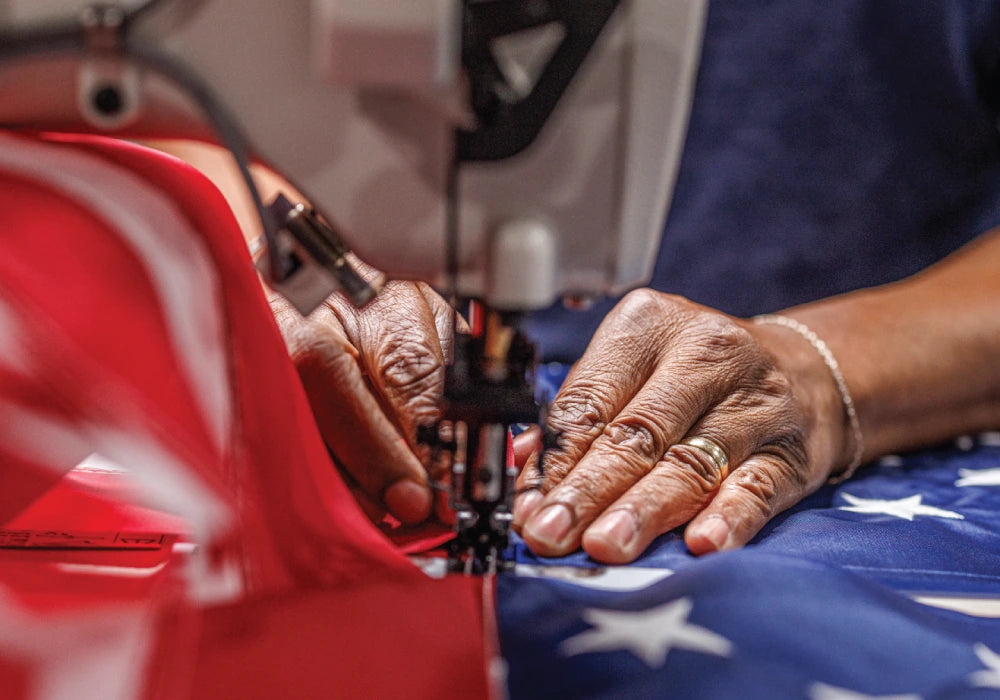
With the stripes and canton cut, the focus shifts to stitching them together. This is where traditional craftsmanship truly meets mechanical efficiency. Sewists piece the flag together, stripe by stripe. The 13 stripes must be sewn with their seams perfectly straight and the colors alternating in the correct order. Typically, manufacturers use industrial sewing machines with special jigs or guides to keep long seams aligned. The stripes are usually joined with a flat-felled seam, which is a durable overlapping seam that lies flat. This technique not only gives the flag a neat, low-profile seam but also reinforces it against stress and fraying. Each stripe is carefully aligned to its neighbor to ensure straight, continuous bands across the flag. The sewing operator will often pause to check that no puckering or misalignment is occurring, as even slight deviations would be very noticeable on the finished flag’s stripes.

Embroidering the Stars on the Canton
Of all the elements of the flag, the star-spangled blue canton might require the most specialized craftsmanship. The canton carries the 50 white stars that represent the states. High-quality flags use two main methods to add stars: embroidery or appliqué, and the choice often depends on the flag’s size and purpose.
Finishing Touches: Headers, Grommets, and Quality Control
After the main body of the flag is assembled, flag makers add a few critical finishing touches. First, the header is attached along the flag’s hoist side. The header is usually a strip of heavy-duty fabric about 2 inches wide that gets folded over the edge. This reinforces the side of the flag that will take the most strain, as it’s where the flag is fastened and bears the pulling force of the wind. The canvas header is sewn on with multiple rows of stitching, effectively binding it to the flag’s edge. You can often see two parallel lines of stitching running down the length of the header on a finished flag, indicating how securely it’s stitched.
Once the header is in place, metal grommets are inserted. Grommets are brass or stainless steel ringed eyelets that create a sturdy hole through which the flag can be attached to a pole’s hooks or a rope line. Typically, two grommets are used on flags up to a certain size. Very large flags might have extra grommets or rope loops sewn in for additional support. Using a punch and a press, workers reinforce the header and punch the grommets through both the canvas and flag fabric, crimping each metal ring flat.
The final step before packaging is quality inspection. Manufacturers of high-quality flags made in the USA thoroughly examine each flag. Inspectors will check that all 50 stars are present and properly secured, that the stitching on stripes is even and free of loose threads, and that the dimensions are correct. They also look at color consistency. The red should be uniform across all stripes, and the blue canton a consistent shade, with no blotches or fading. Flags are often laid out on large tables or light boxes for inspection so that any holes, stains, or mis-sewn seams become apparent. The fly end is scrutinized too, as this part is prone to fraying. Many quality flags incorporate extra stitching at the fly end, such as additional zig-zag stitches or a double fold, to give them more life. If any defect is found, that flag is pulled from the line for repair or designation as a second-quality product. The goal is that only top-tier flags leave the factory floor.
After passing inspection, flags are folded or rolled for packaging. Labels indicating size and material are attached, often with a statement like “Made in USA” proudly displayed. At this point, consumers can be confident that the flag they receive has been crafted with respect and care. For a truly all-American product, even the accessories can be domestically made. One can pair the flag with flagpoles made in the USA and American-made mounting hardware to ensure every component of the display supports local craftsmanship.
Handcrafted vs. Mass-Produced: The Human Touch in Flag Making
In the modern era, large textile companies can produce flags by the thousands using highly automated processes, yet there remains a market and appreciation for the more artisanal approach. The difference between a mass-produced flag and a “handcrafted” flag often comes down to the level of detail and human involvement in its making. Custom flags made in the USA for special purposes are frequently made in smaller batches or even one at a time, allowing skilled artisans to devote extra attention to each piece.
By contrast, a mass-produced flag rolling off an assembly line is designed for efficiency. Automation, such as computer-controlled cutting and multi-head embroidery machines, ensures consistency across thousands of units. This means a flag from a big factory will look virtually identical to any other flag of the same batch. The benefit is that it keeps costs down and output high, making flags readily available and affordable to millions of people. However, mass production can sometimes mean lighter materials or fewer reinforcement steps, so cheaper flags may not last as long under heavy use. The best American flag company is arguably one that balances these approaches: using modern manufacturing to achieve precision and consistency, while still employing skilled workers to add quality control and craftsmanship at critical steps.
A craftsperson-guided process might run a single flag through a sewing machine at a time, carefully guiding each seam, as opposed to an operator watching dozens of flags being sewn simultaneously by automated equipment. Handcrafted flags are meticulously assembled by skilled artisans who devote attention to every stitch, often using traditional techniques that result in superior durability and unique character, whereas mass-produced flags rely more on automated machinery for rapid, cost-effective output, sacrificing the personalized touch and some level of detail.
Why American-Made Flags Matter
Many Americans specifically seek out USA flags made in America to ensure authenticity and to support domestic manufacturing. This demand has even reached the halls of government: in recent years, Congress passed legislation requiring that any American flags bought by federal agencies be 100% made in the United States. The push came after revelations that a significant number of U.S. flags were being imported. In 2017, an estimated 10 million American flags were imported into the U.S., and 99.5% of those came from China. This sobering statistic prompted efforts to bring flag-making back home, bolstering requirements that government flags use American-made materials and labor. It helps U.S. flag factories thrive and ensures that the flag flying over a government building or a soldier’s casket was made by American hands.
Choosing an American-made flag often means getting a higher-quality product. Domestic manufacturers tend to use better materials and adhere to stricter quality controls. They are also more likely to follow the official U.S. Flag Code dimensions precisely. Organizations like the Flag Manufacturers Association of America (FMAA) certify flag makers who produce in the U.S. with U.S.-sourced materials; an FMAA seal on packaging gives buyers confidence that the flag is truly American-made and not a cheap import in disguise. Shoppers need to stay vigilant when they buy American flags online, reading product descriptions and looking for phrases like "Made in USA" or specific company names that are known U.S. flag makers. It’s often worth paying a bit more for a flag from a reputable American source than a bargain bin import that may tear or discolor after a few weeks outdoors.
Patronizing U.S. manufacturers has broader benefits as well. It supports local economies and American jobs in textile mills, sewing shops, and distribution. The people making American flags take genuine pride in their work. Many companies, such as Allegiance, have long histories and view their craft as a patriotic duty as much as a business. The top U.S flags on the market are virtually always those made in America by these experienced companies. They understand the responsibility of producing the nation’s most honored symbol. Moreover, American-made flags undergo rigorous testing for colorfastness, strength, and durability. Consumers who purchase USA flags that carry the Made-in-USA label often report that those flags last significantly longer in the field than the flimsier imports.

From the first handmade American flag stitched in the 18th century to the advanced manufacturing techniques of today, the way American flags are made has continually evolved, but it has never lost its connection to skilled craftsmanship. Each flag carries with it a legacy of those who designed, sewn, and cared for this emblem over the generations. The process of making an American flag is filled with respect and attention to detail at every turn. Modern flag factories might hum with automated looms and embroidery machines, but they are still guided by human expertise and a sense of tradition. And in small workshops, dedicated artisans keep the old ways alive with needle and thread, one star and stripe at a time.
Sources
-
Fox News – Sewn with pride: Flag factory gears up for 250th anniversary of nation (Olivianna Calmes, July 2024) foxnews.com
-
Bangor Daily News (AP) – Susan Collins leads push to require American flags be made in the US bangordailynews.com
-
Show Allegiance – Crafting the American Flag: Materials & Manufacturing Process showallegiance.com